



22 Oct The impact of climate change on human health
• The WHO estimates that, between 2000 and 2019, around 489,000 people died each year from heat-related causes.
• Older people, young children, pregnant women and patients with cardiovascular, renal or respiratory diseases are particularly vulnerable to extreme heat.
• The tiger mosquito is now established in 369 European regions, compared with 114 a decade ago, and locally acquired mosquito-borne infections are reaching record levels in Europe.
Climate change is no longer solely an environmental issue; it has become a direct challenge to human health. The build-up of greenhouse gases – carbon dioxide, methane and nitrous oxide – mainly from burning fossil fuels, industry, transport, certain agricultural activities and deforestation, traps heat that the Earth would otherwise release into space. The result is a warmer atmosphere and warmer oceans, with changes in rainfall, air circulation and ocean currents.
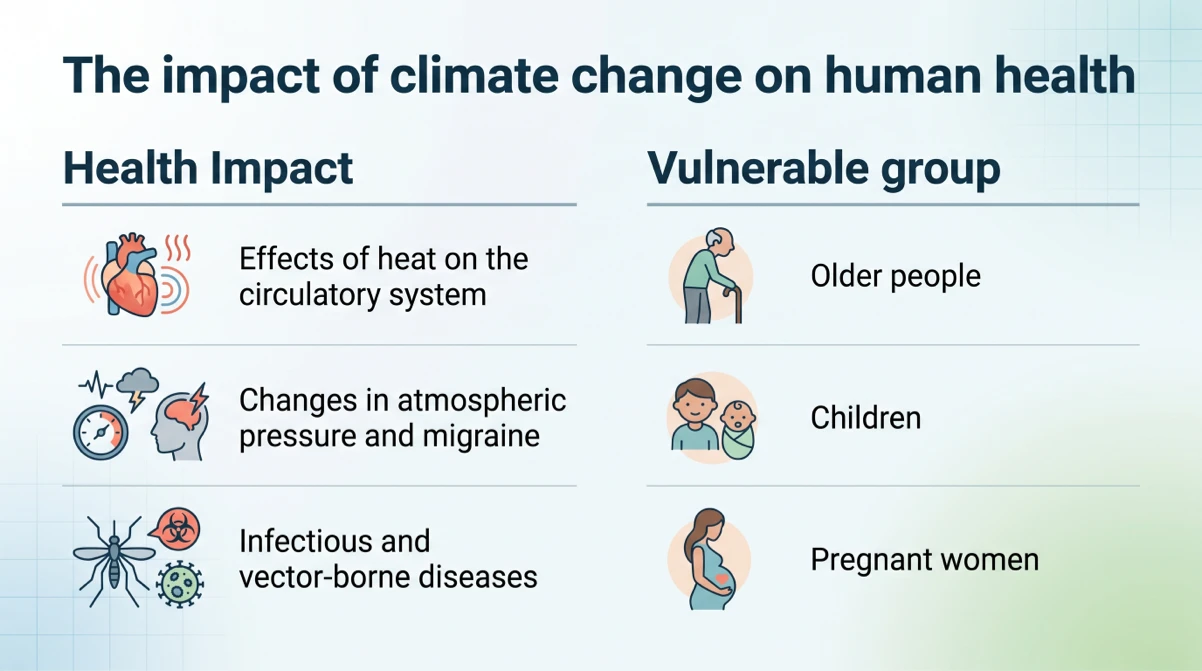
Effects of heat on the circulatory system
The most immediate consequence is more frequent and intense exposure to heat. In addition to acute conditions such as heat exhaustion and heatstroke, high temperatures place additional strain on the circulatory system. To cool itself, the body dilates the blood vessels in the skin and increases sweating, which reduces vascular resistance and causes loss of water and mineral salts. This reduces circulating plasma volume, and the heart must beat faster to maintain blood flow to the organs. Blood pressure may fall, and dizziness, fainting, electrolyte disturbances and changes in blood clotting may occur. In people with pre-existing cardiovascular disease, this additional strain can lead to decompensation and increase the risk of acute events.
Older people
With age, the sensation of thirst, the ability to sweat and thermoregulatory mechanisms become less effective. According to the WHO, heat-related mortality among people aged over 65 was approximately 85% higher in 2017-2021 than in 2000-2004, and a study published in Nature Medicine estimated 62,775 heat-related deaths in Europe during the summer of 2024. Some commonly used treatments – diuretics, antihypertensives and beta-blockers – can also affect hydration, blood pressure or the body’s response to heat. They should not be discontinued during a heatwave, but they do warrant closer monitoring of people with chronic conditions, particularly during prolonged episodes or when night-time temperatures offer the body little opportunity to recover.
Children
Children, particularly infants, also tolerate heat less well. According to UNICEF, they take longer than adults to increase sweating and acclimatise, and they become dehydrated more easily because water accounts for a greater proportion of their body weight. They also depend on adults to keep them hydrated and protected. UNICEF estimated that 377 children died in 2021 as a result of rising temperatures in Europe and Central Asia, around half of them during their first year of life. Heat exposure in childhood is associated with heatstroke, diarrhoea and worsening asthma, and the WHO stresses that a child should never be left in a parked vehicle.
Pregnant women
A study published in Environment International in 2026, based on 36.6 million births in 250 locations across 13 countries – including Spain – linked high temperatures to an increased risk of preterm birth: 2.8% higher on days of moderate heat and 3.8% higher during extreme heat. According to the authors, around 1.4% of preterm births during the warm season are attributable to heat. Maternal dehydration, changes in placental blood flow and inflammation are possible mechanisms underlying this association.
Changes in atmospheric pressure and migraine
Warming also alters the dynamics of the atmosphere and oceans and can contribute to rapid changes in temperature, humidity and atmospheric pressure. In this area, the health evidence is more limited than it is for heat. The most consistent association has been observed in migraine: recent reviews describe a relationship between certain changes in pressure and the onset of attacks in some patients, although the findings are not uniform. In addition, because pressure often changes alongside temperature and humidity, it is difficult to isolate its effect. It is therefore more appropriate to speak of individual susceptibility than of a universal effect.
Infectious and vector-borne diseases
Milder winters, longer summers and changes in rainfall extend both the geographical range and the season in which mosquitoes can transmit disease. The European Centre for Disease Prevention and Control (ECDC) warns that Europe is facing longer and more intense mosquito seasons as a result of climate change. The tiger mosquito (Aedes albopictus), which can transmit dengue, chikungunya and Zika, is established in 369 regions across 16 European countries. In Spain, where it was first detected in 2004 in Sant Cugat del Vallès (Barcelona), it is present in more than 1,700 municipalities. Locally acquired dengue cases in Europe rose from 71 in 2022 to 304 in 2024, while 2025 saw a record number of chikungunya outbreaks. West Nile virus, transmitted by Culex mosquitoes, has caused 1,569 locally acquired cases in 16 European countries during the 2026 season, including 125 in Spain, according to ECDC data as at 23 September. In addition, warming seas favour the proliferation of bacteria of the genus Vibrio in coastal waters.
A public health issue
Extreme events – floods, wildfires and severe storms – add to these impacts, causing injuries, disruption to healthcare services and displacement. Reducing emissions and implementing adaptation measures – heat-health prevention plans, early-warning systems, cities with more shade and vegetation, better-prepared buildings, monitoring of vulnerable people and vector surveillance – are not merely environmental policies; they are public health tools that protect people from a climate that is already transforming our living conditions. Understanding how the body responds to increasingly extreme temperatures helps us anticipate risks and better protect the population in a climate scenario that is already changing the conditions in which we live.
Sources:
- World Health Organization (WHO). Climate change, heat and health. Fact sheet. https://www.who.int/news-room/fact-sheets/detail/climate-change-heat-and-health
- Janoš T, et al. Heat-related mortality in Europe during 2024 and health emergency forecasting to reduce preventable deaths. Nature Medicine. 2025;31(12):4065–4074. https://doi.org/10.1038/s41591-025-03954-7
- UNICEF. Beat the heat: Protecting children from heatwaves in Europe and Central Asia. July 2023. https://www.unicef.org/eca/reports/beat-heat
- UNICEF. Rising heat across Europe and Central Asia kills nearly 400 children a year. Press release, 24 July 2024. https://www.unicef.org/greece/en/press-releases/rising-heat-across-europe-and-central-asia-kills-nearly-400-children-year-unicef
- Íñiguez C, et al. The burden of premature births attributed to heat across 13 countries. Environment International. 2026;212:110286. https://doi.org/10.1016/j.envint.2026.110286
- Whether Weather Matters with Migraine. Current Pain and Headache Reports. 2024;28(4):181–187. https://doi.org/10.1007/s11916-024-01216-8
- European Centre for Disease Prevention and Control (ECDC). New ECDC weekly reports and guidance to tackle mosquito-borne diseases across Europe. 1 July 2025. https://www.ecdc.europa.eu/en/news-events/new-ecdc-weekly-reports-and-guidance-tackle-mosquito-borne-diseases-across-europe
- ECDC. World Mosquito Day 2025: Europe sets new records for mosquito-borne diseases. 20 August 2025. https://www.ecdc.europa.eu/en/news-events/world-mosquito-day-2025-europe-sets-new-records-mosquito-borne-diseases
- ECDC. West Nile virus infection – Weekly epidemiological summary. 2026 season (data as of 23 September 2026). https://wnv-weekly.ecdc.europa.eu/
- 3Cat. El mosquit tigre ja ha colonitzat pràcticament tot Catalunya, 20 anys després de la seva arribada [The tiger mosquito has now colonised virtually all of Catalonia, 20 years after its arrival]. 4 September 2025. https://www.3cat.cat/3catinfo/el-mosquit-tigre-ja-ha-colonitzat-practicament-tot-catalunya-20-anys-despres-de-la-seva-arribada/noticia/3368257/
- ECDC. Increased risk of Vibrio infections throughout the summer season. https://www.ecdc.europa.eu/en/news-events/increased-risk-vibrio-infections-throughout-summer-season