



19 Nov Antimicrobial Resistance (AMR)
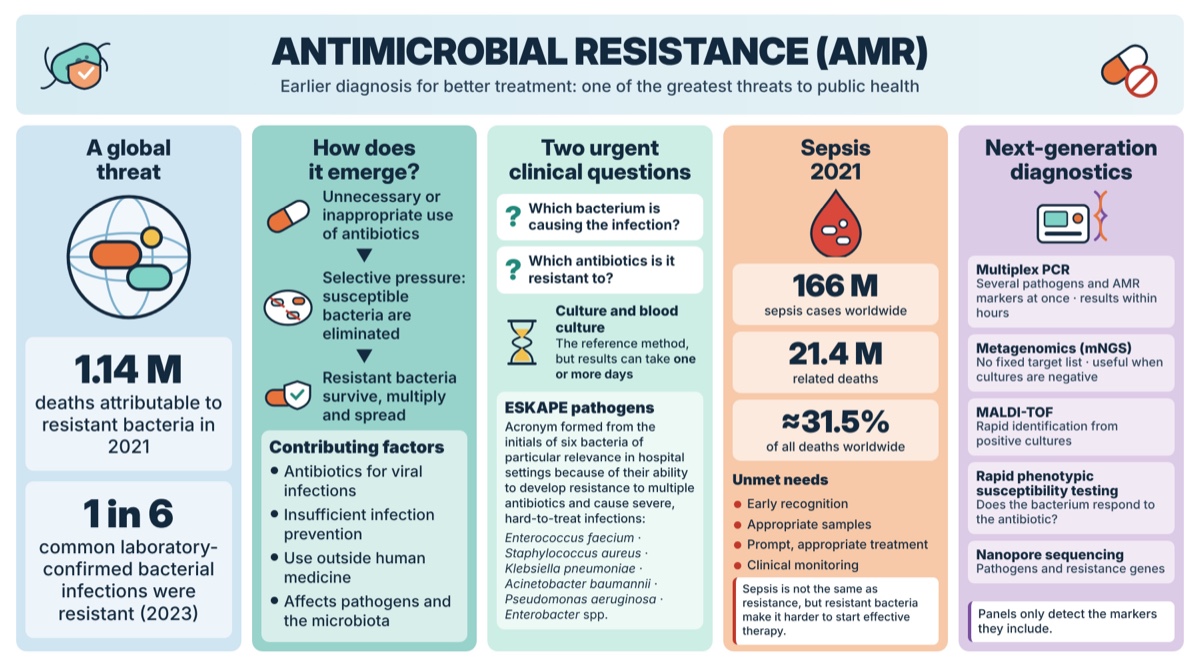
• Bacterial resistance to antibiotics caused approximately 1.14 million deaths in 2021.
• Rapidly identifying the bacterium causing an infection and detecting its resistance mechanisms are two decisive challenges in choosing the right treatment.
• Sepsis heightens diagnostic urgency: an estimated 166 million cases and 21.4 million related deaths occurred in 2021.
• Multiplex PCR, metagenomics and rapid susceptibility testing can complement culture and speed up clinical decision-making.
Antimicrobial resistance (AMR) has become established as one of the greatest threats to public health. In the case of antibiotics, the problem arises when bacteria acquire or develop mechanisms that reduce the effectiveness of drugs that were previously useful. As a result, common infections may require more complex treatment and longer hospital stays and, in severe cases, survival may be compromised. According to an analysis published in The Lancet in 2024, in 2021 bacterial resistance was directly responsible for some 1.14 million deaths owing to treatments in which the effective antibiotic arrived too late.
The unnecessary use of antibiotics (for example, to treat viral infections) and their inappropriate use favour the selection of resistant bacteria. This happens because antibiotics exert selective pressure on bacterial populations: while susceptible bacteria are eliminated or have their growth inhibited, those with resistance mechanisms can survive and multiply, increasing their transmission within the population. This phenomenon can occur both in the bacteria responsible for an infection and in those that form part of the body’s microbiota.
Other contributing factors include insufficient infection prevention and the use of antimicrobials outside human medicine. In its 2025 surveillance report, the World Health Organization (WHO) warned that, among common laboratory-confirmed bacterial infections in 2023, approximately one in six was resistant to the antibiotics tested [2].
Two clinical questions that demand rapid answers
When faced with a potentially serious infection, clinicians need to resolve two complementary questions: which microorganism is causing the illness and which antibiotics it may be resistant to. Without this information, it is often necessary to start empirical treatment, frequently broad-spectrum, so as not to lose time. The priority is to treat seriously ill patients as soon as possible and, in parallel, to adjust treatment when microbiological results arrive. Delaying an effective antibiotic can worsen the prognosis; prolonging an unnecessarily broad one also increases the selective pressure on bacteria.
Microbiological culture and, in bloodstream infections, blood culture are the reference methods because they make it possible to recover and identify the microorganism. However, bacterial growth takes time, and identification followed by antimicrobial susceptibility testing can delay definitive results by one or more days. It is worth clarifying that culture does allow resistance to be studied: it does so through phenotypic susceptibility tests that directly assess the bacterium’s response to different antibiotics. Its main limitation is not an inability to detect resistance, but the delay, which is particularly problematic in critically ill patients.
Resistant bacteria complicate the management of pneumonia and of urinary, intra-abdominal, wound and bloodstream infections. In hospital settings, the pathogens grouped under the acronym ESKAPE are of particular concern: Enterococcus faecium, Staphylococcus aureus, Klebsiella pneumoniae, Acinetobacter baumannii, Pseudomonas aeruginosa and Enterobacter spp. These microorganisms can accumulate resistance mechanisms and cause infections that are difficult to treat, particularly in vulnerable people.
Sepsis
Among bacterial infections, one of the most serious complications is sepsis, which occurs when the body’s response becomes dysregulated and causes life-threatening organ dysfunction. Sepsis is not the same as antibiotic resistance (it can also be caused by susceptible microorganisms and by other infectious causes), but the presence of resistant bacteria can make it harder to start effective therapy. According to a study published in The Lancet Global Health in October 2025, an estimated 166 million cases of sepsis occurred worldwide in 2021, with 21.4 million related deaths, representing approximately 31.5% of all deaths globally. The study notes that the global burden of sepsis increased during 2020 and 2021, against the backdrop of the COVID-19 pandemic.
In this context, every decision counts. Early recognition of sepsis, collection of appropriate samples, prompt administration of the indicated treatment and clinical monitoring are the cornerstones of management. Biomarkers such as C-reactive protein or procalcitonin can provide additional information, but none of them alone reliably identifies the causative bacterium or replaces microbiological testing or medical assessment.
The new generation of microbiological diagnostics
Molecular technologies offer a promising way to reduce uncertainty. Multiplex PCR simultaneously detects genetic material from several pathogens and specific antibiotic resistance genes or markers (AMR markers). Some panels can deliver results within hours and report, for example, the presence of specific resistance mechanisms, enabling earlier clinical decisions. However, these tests have limitations: they can only detect the genes or markers included in the panel. Consequently, the absence of the markers tested neither rules out other resistance mechanisms in the bacterium nor guarantees its susceptibility to antibiotics.
Metagenomic next-generation sequencing (mNGS) analyses the genetic material present in a sample without being limited to a closed list of microorganisms. This can be especially valuable in complex infections or when cultures are negative. As well as identifying potential pathogens, it can reveal resistance-associated genes, although interpretation requires distinguishing between contamination, colonisation and true infection, and bearing in mind that the presence of a gene does not always fully predict how the bacterium will respond to treatment.
Other tools complement this progress. MALDI-TOF mass spectrometry speeds up the identification of microorganisms, particularly from positive cultures. Rapid phenotypic susceptibility tests aim to determine more quickly whether a bacterium responds to an antibiotic. Meanwhile, targeted sequencing techniques, including nanopore technology, offer new possibilities for characterising pathogens and genetic determinants of resistance. The clinical usefulness of each option depends on the sample, its validation and its integration into the care pathway.
Earlier diagnosis for better treatment
The greatest impact will come from combining rapid diagnostics, antimicrobial susceptibility testing, clinical microbiology teams and antimicrobial stewardship programmes. The aim is not to replace culture indiscriminately, but to complement it and ensure that relevant information reaches the clinician while it can still change the prognosis.
Curbing antibiotic resistance requires preventing infections, prescribing responsibly, strengthening surveillance and developing new treatments. But it also requires better and earlier diagnosis. Knowing which bacterium is causing an infection and anticipating which antibiotics might fail paves the way towards more precise medicine: protecting each patient without compromising the effectiveness of antibiotics for those who will need them in the future.
Sources and references
[1] GBD 2021 Antimicrobial Resistance Collaborators. The Lancet (2024). https://pubmed.ncbi.nlm.nih.gov/39299261/
[2] WHO. Global antibiotic resistance surveillance report 2025 (2025). https://www.who.int/publications/i/item/9789240116337/
[3] WHO. Sepsis, fact sheet (2024; 2017 estimates). https://www.who.int/news-room/fact-sheets/detail/sepsis
[4] American Society for Microbiology. Clinical Microbiology Reviews (2025). https://doi.org/10.1128/cmr.00137-24
[5] Examples of diagnostic technologies: Communications Medicine (2024). https://www.nature.com/articles/s43856-024-00487-x