



26 May Opportunities in Healthy Aging
Article by Natalia de la Figuera – Co-founder and COO of GENESIS Biomed
• Rising life expectancy and increasing pressure on healthcare and social systems are driving a new market focused on prevention, independence, and quality of life for older adults.
• Healthy aging is establishing itself as one of the major growth areas in health, well-being, and technological innovation.
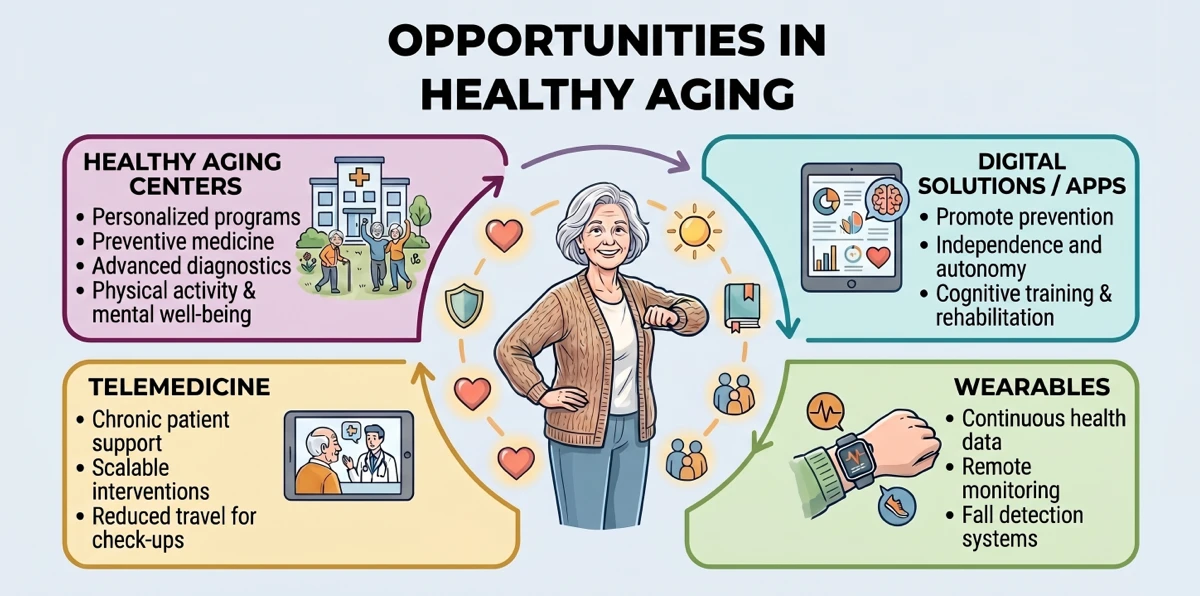
• Healthy aging centers, digital solutions/apps, wearables, and telemedicine open up a wide range of opportunities for companies, investors, healthcare centers, and entrepreneurs.
The world’s population is living longer than ever before. In developed countries, life expectancy has risen steadily over the past decades, to the point where each new generation lives several years longer than the previous one. In Spain, life expectancy at birth stood at 83.9 years in 2023, with 81.1 years for men and 86.6 years for women, according to data from the Ministry of Health.
This progress, which constitutes one of the greatest social and health achievements of recent decades, also places growing pressure on healthcare, social-health, and long-term care systems. The European Commission, in its Ageing Report 2024, warns of the budgetary impact of population aging on pensions, health, long-term care, and other components of public spending through 2070. In this context, aging is no longer merely a demographic issue but has become one of the major economic, health, and social challenges of the coming decades. The challenge is not merely to live longer, but to live better and with a lower economic impact on public spending.
It is precisely in response to this challenge that the concept of “healthy aging” gains traction. The World Health Organization defines it as the process of developing and maintaining functional capacity that enables well-being in old age. This functional capacity includes essential aspects such as mobility, autonomy, decision-making, maintaining social relationships, and the ability to continue contributing to society.
Healthy aging therefore represents a paradigm shift: moving from a model focused primarily on treating disease to one also oriented toward preventing illness and prolonging autonomy. Preserving cognitive function and maintaining physical fitness play an important role in this autonomy. This new approach opens up a vast and growing market. The global market for the health and well-being of older adults was estimated at $1.4 trillion in 2024, with a projected compound annual growth rate of 8.5% for the period 2024–2033. Beyond these figures, the health and wellness segment for older adults has become one of the areas of greatest interest within the so-called senior economy.
One of the most visible trends in this field of healthy aging is the emergence of centers and hubs specializing in healthy aging. These centers combine preventive medicine, advanced diagnostics, nutrition, physical activity, mental well-being, sleep, rehabilitation, and personalized programs.
Digital solutions/apps promoting prevention and independence are another major driver of healthy aging. In the cognitive domain, assessment, training, and rehabilitation apps allow for the monitoring of functions such as memory, attention, processing speed, and planning, as well as the design of specific brain training programs. There are also virtual reality programs for cognitive stimulation. These tools do not replace clinical assessment, but they can contribute to earlier detection, more continuous monitoring, and greater personal involvement in the care of one’s cognitive health. But healthy aging goes beyond the strictly clinical dimension, which is why there are also apps to promote healthy habits, digital programs for adapted exercise, personalized nutrition solutions, platforms to improve sleep quality, socialization tools to combat unwanted loneliness, community programs focused on active aging, and more. There is, therefore, a holistic approach that constitutes one of the main trends in the sector, integrating nutrition, physical exercise, sleep, memory, emotional well-being, and socialization.
Wearables are also transforming the sector. Smartwatches, sensors, electrocardiogram devices, and fall detection systems enable remote monitoring, generating continuous data on health-related parameters.
Telemedicine completes this ecosystem. Its value lies in facilitating the monitoring of chronic patients, reducing travel, maintaining contact with healthcare professionals, and promoting low-cost, highly scalable interventions. However, the scientific literature indicates that while digital technologies have the potential to modernize healthcare and meet the needs of increasingly aging populations, their adoption requires overcoming barriers to usability and access among a population that values in-person doctor visits, even though acceptance is growing among future generations.
In this context, healthy aging represents a strategic opportunity for the health innovation ecosystem. For companies, it represents an expanding market with needs that remain largely unmet. For healthcare centers, it involves moving toward preventive models and continuity of care. For investors, it opens up a cross-cutting category that connects digital health, medtech, wellness, nutrition, artificial intelligence, connected devices, and personalized services. And for society, it offers the possibility of turning increased longevity into a stage of greater autonomy, participation, and quality of life. Longevity should not be understood as a promise of indefinite youth, but rather as a strategy to increase the number of years lived in good health, with functionality and independence. The main opportunities for healthy aging lie in this balance between science, prevention, technology, and accessibility.