



09 Jul What do the Catalan healthcare startups that raised the most funding in 2025 have in common?
Article by Natalia de la Figuera – Co-founder and COO of GENESIS Biomed
• The largest funding rounds of 2025 were concentrated in companies that combine an unmet need, solid evidence, and the potential for international scaling.
• Regulatory and clinical maturity is emerging as one of the most important factors for securing large funding rounds, especially in biotechnology and medical technology.
• Founding teams with prior experience in technology transfer, clinical development, or successful entrepreneurship are a recurring feature among the most significant deals.
Lists of the largest funding rounds are often interpreted as a ranking of winners and losers. However, behind the numbers lies a much more interesting question for entrepreneurs, investors, and innovation managers: What characteristics do the companies that attract the most capital have in common?
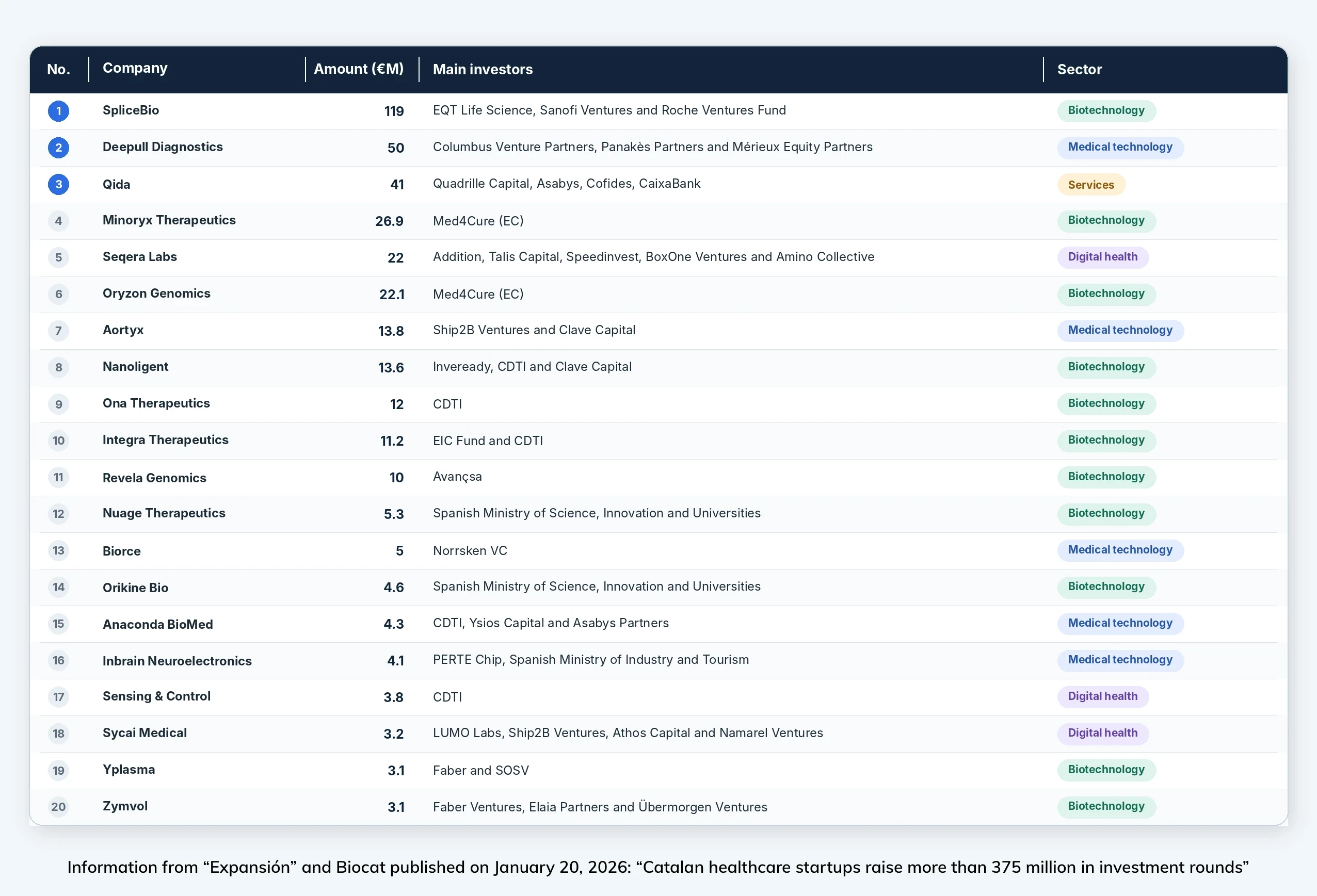
An analysis of the major deals closed by Catalan health tech startups in 2025 reveals fairly consistent patterns. Although the companies operate in different segments—ranging from gene therapy to molecular diagnostics, digital health, and home care—many of them share strategic elements that help explain why investors have backed them.
- Unmet Need: The first pattern is a commitment to addressing a relevant and clearly defined clinical unmet need. The largest funding rounds have targeted technologies that aim to address significant medical needs. SpliceBio, which tops the ranking with a €119 million funding round, develops gene therapies for hereditary diseases that currently lack effective treatments. Deepull is working on the rapid diagnosis of sepsis, one of the leading causes of hospital mortality. Minoryx Therapeutics focuses on rare neurological diseases. Even Qida, the leading operation in the healthcare sector, addresses one of Europe’s major demographic challenges: care for dependent elderly individuals.
- Technology that is difficult to replicate and well-protected: The companies leading the way in raising capital possess their own intellectual property, distinctive technological platforms, or scientific capabilities that are difficult to replicate. SpliceBio’s protein splicing technology, Deepull’s molecular solutions for rapid diagnosis, and the developments from companies such as Integra Therapeutics, Ona Therapeutics, and Oryzon Genomics are examples of models based on high scientific and technological barriers.
- Project maturity: A third recurring factor is the level of maturity the projects have reached. Significant funding comes when the scientific promise has already been supported by robust preclinical evidence, initial clinical trials, or relevant regulatory milestones. SpliceBio’s funding round comes as its clinical programs are already underway, while Deepull’s round aims to accelerate the clinical validation and regulatory process for its diagnostic platform.
- Platform models: Investors are not just looking for a specific product; they are seeking technologies capable of generating multiple future products. This logic is particularly evident in gene therapy, biotechnology, and digital tools. A scalable platform offers more opportunities for growth, diversification, and value creation than a solution designed for a single indication. This approach justifies higher valuations and attracts larger specialized funding rounds.
- Strong Team: The most significant funding rounds tend to focus on companies led by individuals with prior experience in top-tier research, technology transfer, product development, or entrepreneurship. In some cases, these leaders have a track record of founding successful companies; therefore, for many investors, the team remains one of the key indicators of future execution capability.
Finally, the 2025 deals highlight that public and private funding are increasingly acting as complementary mechanisms. Several companies in the ranking combined venture capital with competitive grants, European programs, or public instruments supporting innovation. Far from replacing private investment, these resources help reduce technological risks and accelerate milestones that subsequently facilitate the entry of new investors.
The conclusion is clear. The startups that raised the most funding in 2025 share a combination of distinctive science, growing evidence, a global vision, and execution capability. Investors continue to seek disruptive innovation, but they increasingly show a preference for projects that have demonstrated tangible progress and have a clear strategy for transforming knowledge into clinical impact and economic value. In an environment where capital remains selective, the funding rounds of 2025 suggest that success— —no longer depends solely on having a good idea. It depends on building companies capable of demonstrating that this idea can become a real solution for patients, healthcare systems, and international markets.