



05 Nov Montserrat Bernabeu Guitart – Co-director and Director of Clinical Care at the Institut Guttmann
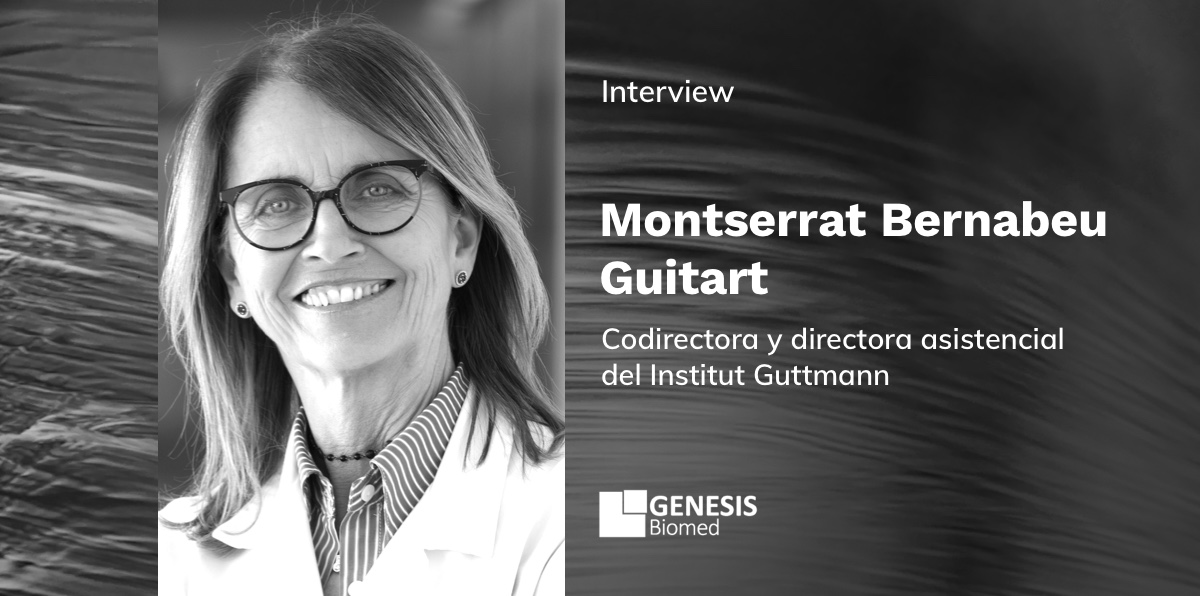
Montserrat Bernabeu Guitart: “innovation and knowledge transfer play a strategic role at Guttmann”
Montserrat Bernabeu Guitart is a specialist in Physical Medicine and Rehabilitation, and Co-director and Director of Clinical Care at the Institut Guttmann, where she has worked since 1993. She was Head of the Brain Injury Unit from 1997 to 2018 and has taken part in European projects on new rehabilitation technologies. She was President of the Spanish Society of Neurorehabilitation (SENR) from 2005 and a member of the Board of Directors of the International Society of Physical and Rehabilitation Medicine (ISPRM).
The Institut Guttmann has historically been a leading centre for spinal cord injury and acquired brain injury, but in recent years it has broadened its activities towards the wider concept of brain health. What are Guttmann’s main areas of growth today, and what new care needs do you think will shape the coming years?
The Institut Guttmann keeps the neurorehabilitation of spinal cord injury and acquired brain injury at the heart of its activity. However, our main areas of growth now focus on developing the concept of brain health, with a progressive expansion into neuropsychiatric disorders, neurodevelopmental disorders, the prevention of cognitive decline, healthy ageing and applied neuroscience. At the same time, Guttmann is committed to neuromodulation, digital technologies, artificial intelligence, personalised medicine and translational research as distinguishing features of its model.
Looking ahead, care needs will be shaped by the rise in neurological and neurodegenerative diseases, the cognitive and behavioural sequelae of neurological disorders, the increase in mental health problems, the need to preserve brain health throughout life, and the demand for more personalised and digital models of care, geared towards the active participation of individuals in their own health.
In spinal cord injury or acquired brain injury, how crucial is it to start neurorehabilitation early? Is there still room to improve coordination between acute hospitals and specialist centres, so that patients can access the right treatment sooner?
Early intervention is a very important factor, but it must be properly understood: starting early does not mean acting hastily, but beginning neurorehabilitation as soon as the person is clinically stable, at an intensity adapted to their situation. In spinal cord injury and acquired brain injury, the first few weeks are particularly important, as they coincide with a period of great potential for recovery and neuroplasticity. Early, specialised intervention makes it possible to make better use of this potential, prevents secondary complications — such as stiffness, pressure ulcers, infections, pain or deconditioning — and starts working on the person’s autonomy, communication and participation from the very outset.
However, early intervention alone is not enough. The specialisation of the team, continuity of care, appropriate intensity and the setting of goals shared with the patient and their family are also essential. It is not just a matter of transferring patients sooner, but of ensuring that each person accesses the most suitable resource at the right time and without avoidable interruptions to the therapeutic process.
And yes, there is still room for improvement in coordination between acute hospitals and specialist centres. We need to move towards more agile referral pathways, shared criteria, early specialist assessments — even before transfer — and a smoother exchange of clinical and functional information. Neurorehabilitation should begin during the acute phase and continue without interruption between centres. This networked model is what can ensure that no clinically useful time is lost and that all patients, regardless of where they receive initial treatment, have equitable access to the specialist treatment they need.
Technology is advancing at a dizzying pace. Which innovations do you think will most transform patients’ recovery and quality of life in the field of brain health over the coming years? What role do innovation and knowledge transfer play at the Institut Guttmann?
In the coming years, the transformation will not come from a single technology, but from the convergence of neuroscience, data and engineering. We will see significant advances in personalised neuromodulation, intelligent robotics, exoskeletons, brain–computer interfaces, virtual reality and digital technologies that make it possible to extend treatment beyond the hospital. Artificial intelligence will also play an important role, helping us to integrate clinical, functional and neurophysiological information, to better predict how a condition will progress and to tailor treatments to each person’s needs.
But it is important to stress that technology is not an end in itself. It is only truly innovative if it delivers clinical value, improves the person’s autonomy and participation, and is accessible and sustainable. For this reason, before a new solution is adopted, it must be shown to be safe, effective and useful in real life. The future will be increasingly personalised: it will not be about applying more technology to everyone, but about identifying which intervention works best, for which patient, at what time and at what intensity.
In this context, innovation and knowledge transfer play a strategic role at Guttmann. The combination of a specialist hospital and a University Institute allows us to identify needs directly in clinical practice, turn them into research questions and validate solutions with patients and professionals. The aim is to close the gap between scientific knowledge and its clinical application, so that whatever proves valuable reaches people as soon as possible.
For many years we have associated rehabilitation mainly with recovering lost functions. Today, however, technologies aimed at increasing autonomy are becoming ever more important. Is the very concept of rehabilitation changing, shifting from ‘recovering function’ to ‘maximising autonomy and participation’?
Yes, without a doubt, but I would not say that we are replacing one goal with another. Rehabilitation still aims to recover as much function as possible, but today we understand that success cannot be measured solely in terms of motor, cognitive or communicative capacity. The truly relevant outcome is the extent to which the person can make decisions, pursue their life plans and participate in their family, social, educational or working environment.
This means moving from a model focused mainly on the deficit to a more holistic, person-centred model. In some cases we will be able to recover functions; in others, it will be necessary to compensate for or facilitate them through assistive products, augmentative communication, home automation, robotics, environmental adaptations or digital tools. Recovering and compensating are not opposing strategies: they are complementary ways of achieving the greatest possible autonomy.
Technology is accelerating this change, as it allows us to overcome some functional limitations and broaden people’s ability to make choices. However, autonomy does not depend solely on having a device: the solution must be personalised, accessible, easy to use and integrated into everyday life. It is also necessary to act on the environment and remove physical, social and attitudinal barriers.
The concept of rehabilitation is therefore broadening: it is no longer just about training functions, but about building capabilities, opportunities and participation. Ultimately, the goal is not for the person to perform a specific task better within the hospital, but for them to be able to live with the greatest possible autonomy, dignity and quality of life in their real-world environment.
Looking ahead to the next ten years, what would you like to have changed radically in the way we prevent, treat and live with neurological diseases and disabilities? And what role would you like the Institut Guttmann to play in this?
In ten years’ time, I would like us to have moved from a predominantly reactive model to one that is able to anticipate, personalise interventions and support people throughout their lives. I would like brain health to be looked after before disease appears, by acting on risk factors and detecting cognitive, emotional or functional changes in time. And, when a neurological injury or disease does occur, I would like diagnosis, treatment and neurorehabilitation to be integrated into a single process, without fragmentation or avoidable delays.
I would also like treatments to be much more personalised. Combining biomarkers, clinical and functional data, neuroimaging and artificial intelligence should enable us to better understand each person’s potential for recovery and decide which intervention is most appropriate, at what time and at what intensity. But this transformation will only make sense if it reaches everyone: the great challenge will not just be to innovate, but to guarantee equitable access to innovation.
As regards living with disability, I would like us to have moved towards a more inclusive society, in which people can pursue their life plans autonomously and participate fully in family, social, educational and working life. This requires combining functional recovery with assistive technologies, accessible environments and communities willing to remove barriers. Disability does not depend solely on a person’s limitations, but also on the opportunities their environment offers them.
In this future, I would like Guttmann to remain a centre of excellence that brings together highly specialised care, research, innovation, teaching and social commitment. An institute capable of generating knowledge, validating new solutions and transferring them rapidly into clinical practice; but also of sharing this knowledge and contributing to the transformation of the health and social care system.