



14 May Rubén Pérez-Mañanes – Coordinator of UPAM3D (Advanced Planning and 3D Manufacturing Unit) and Head of the Orthopaedic Surgery and Traumatology Department at HGUGM
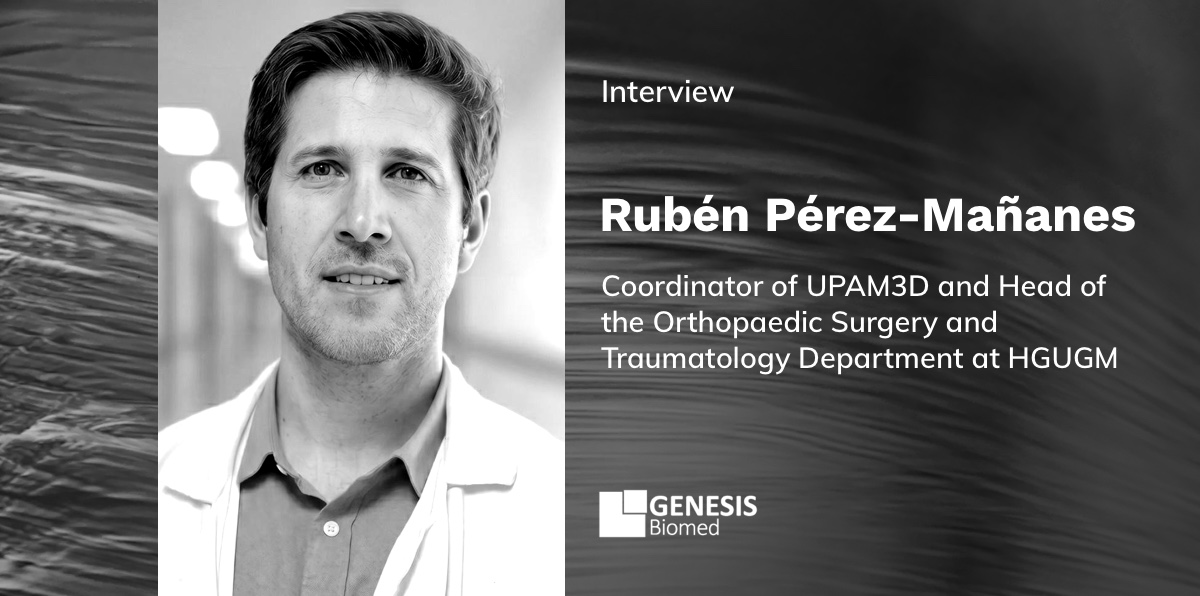
Rubén Pérez-Mañanes: “A public hospital can sustain a regulated, multidisciplinary and scientifically productive manufacturing unit without compromising its healthcare mission”
Rubén Pérez-Mañanes is an orthopaedic oncology surgeon at the HGUGM (Gregorio Marañón University General Hospital), deputy director of the Gregorio Marañón Health Research Institute and an ANECA-accredited lecturer. For over a decade, he has been working at the intersection of medicine and engineering, collaborating closely with clinical engineers and bringing operating room experience into the classroom. Through UPAM3D, he transforms real-world cases into learning pathways based on processes, advanced planning and personalised medicine.
His career is characterised by working at the intersection of disciplines—biomaterials, guided surgery, advanced surgical planning and technologies applied to clinical practice—to generate solutions that deliver value for patients and the healthcare system. He advocates an integrative model, aligned with the One Health approach, based on multidisciplinary teams, open science and purpose-driven technology.
How did UPAM3D emerge and evolve to become a structured hospital unit and a leader in 3D printing?
UPAM3D was established in 2014 at the Gregorio Marañón University General Hospital in response to a very specific clinical need within the Department of Orthopaedic Surgery and Traumatology. The catalyst was, above all, the work of the Sarcoma CSUR (National Health System Reference Unit designated by the Ministry of Health for the treatment of musculoskeletal tumours), where cases of the greatest surgical, reconstructive and oncological complexity are concentrated, alongside complex spinal and pelvic conditions. It is precisely these patients—whose needs no standard protocol can fully address—who make a layer of three-dimensional planning and custom manufacturing essential. The starting point was almost artisanal: domestic hardware, open-source software, and the conviction that advanced surgical planning and custom manufacturing could cease to be an anecdotal resource and become a reproducible clinical tool.
From that embryonic stage, the unit has undergone three structural leaps. The first was its consolidation as the Advanced Planning and 3D Manufacturing Unit, formally recognised within the hospital’s organisational structure and operating under the point-of-care manufacturing model: manufacturing the customised medical device within the same clinical environment where it is prescribed and used. The second was the implementation of a quality management system in accordance with the UNE-EN ISO 13485 standard, which required us to operate with the same rigour as an industrial manufacturer: traceability, design and development control, medical device risk management, process and production controls, and post-market surveillance. And the third, now within the framework of the European Medical Devices Regulation 2017/745, was the granting of the custom-made medical device (CMD) manufacturer’s licence by the Madrid Regional Ministry of Health, which is what truly enables us today to operate as a hospital manufacturing unit with full regulatory guarantees.
To date, 39 hospital departments participate in UPAM3D, which has accumulated more than 2,800 personalised clinical cases and a 3D library of significant educational and research value. But what truly makes it a benchmark is not the volume but having demonstrated that a public hospital can sustain a regulated, multidisciplinary and scientifically productive manufacturing unit without compromising its care mission. That is the logic underpinning the model we have called Marañón Valley: the hospital as an ecosystem of innovation, not as the end user of innovation generated by others.
At UPAM3D, very different profiles work side by side. Is there a growing need for more interdisciplinary teams in hospitals, where roles such as engineers are becoming increasingly important?
Undoubtedly, and it is no longer a question of opportunity but of structural viability. At UPAM3D, doctors, nurses, engineers, imaging technicians, regulatory quality professionals and clinical management staff, amongst others, work side by side. This collaboration is not merely decorative: it is the only way to operate legitimately in the space where clinical decision-making, technical design and regulatory responsibility for the medical device intersect. A surgeon cannot certify a manufacturing process; an engineer cannot replace clinical judgement; a regulatory quality expert cannot do without applied knowledge of the surgery room. That is why we speak of teams fully integrated into the clinical environment, not of one-off remote collaborations.
The problem is that the Spanish healthcare system does not yet have a regulated training and career pathway to integrate the clinical-care engineer into the hospital on a permanent basis. We have an excellent system of Specialised Healthcare Training for healthcare professions (MIR, EIR, FIR, PIR, QIR, BIR, RFIR). The RFIR in Hospital Radiophysics, in particular, serves as a clear regulatory precedent: a technical role fully integrated with legitimate clinical authority. However, there is no INIR or equivalent to establish this role within the Spanish National Health System (SNS). At CEINIR (Strategic Commission for Resident Clinical Engineers), together with a broad group of scientific and professional societies, we argue that this regulatory framework is essential if we want units such as UPAM3D, clinical AI platforms or advanced hospital engineering services to become part of the core healthcare provision. Until that happens, every hospital wishing to replicate this model will come up against the same barrier: there is work to be done, there is demand and there is technology, but there is no regulated professional role for the talent that underpins it.
UPAM3D was born out of a very specific clinical need: to design and manufacture personalised solutions for patients within the framework of personalised medicine. What has this personalisation meant for surgical decision-making?
Personalisation has brought about a qualitative change in the surgical process, not just a quantitative one. Traditionally, the surgeon would plan using two-dimensional images and then encounter the patient’s actual anatomy in the surgery room, adjusting implants and trajectories designed for the average patient on the spot. Today, in complex cases (sarcomas of the pelvis and lower limb, joint revisions with large bone defects, spinal deformities, paediatric oncological reconstructions), we work with a digital twin of the patient that is manipulated, segmented and discussed in a clinical session prior to surgery. Anatomical models, custom surgical guides and, where appropriate, specific implants are designed based on this twin.
The impact on the surgical decision is threefold. Firstly, the decision is made in advance: what we used to decide in the surgery room, we now decide at the planning table, with time, through consultation with colleagues, and with the patient understanding what is going to be done. Secondly, variability is reduced: more predictable oncological margins, reproducible osteotomies, shorter ischaemia time, and lower radiation exposure. And thirdly, complexity is democratised: a case that, in the traditional model, only a few centres could tackle with confidence, becomes more reproducible and auditable with three-dimensional planning and customised guides. This ties in directly with the CSUR (National Health System Reference Centres, Services and Units) framework and with the idea that personalised medicine, far from being a luxury, is a tool for healthcare equity when properly integrated into the public system.
The 4th IiSGM Healthcare Entrepreneurship Conference has established itself as a key event in the healthcare innovation ecosystem of the Community of Madrid. Do you think hospitals are becoming increasingly aware that research and innovation go hand in hand in order to develop solutions that reach the patient?
They are, but we are still in the midst of a cultural transition. For decades, public hospitals have measured their scientific output almost exclusively in terms of publications and bibliometric impact, leaving innovation (understood as solutions that actually reach patients and the healthcare system) out of the picture. That boundary is breaking down, and Health Research Institutes such as the IiSGM, together with its Biomedical Research Foundation (FIBHGM), have been decisive: they are the structure that enables capital, talent and knowledge to be aligned within the hospital ecosystem, and they are the natural bridge to industry, foundations and investors.
What has changed over these four years of the Entrepreneurship Conference is the composition of the audience. It is no longer a forum for dissemination: it is a forum where clinicians, engineers, managers, specialised funds, technology transfer offices and regulators sit down to speak the same language. The conversation has shifted from asking whether we can innovate and undertake entrepreneurial ventures within the hospital to asking under what governance, with what business model and with what return to the system we do so. That is the truly significant leap. And it ties in with an idea I actively champion: the hospital should not merely be the end-user of innovation generated by others, but a legitimate co-developer, with rights, obligations and a share in the value created. The IiSGM Conference is one of the forums where this redefinition of the hospital’s role is taking shape.
Looking at the Community of Madrid as a healthcare innovation ecosystem, what conditions have enabled projects such as UPAM3D to scale up within a public hospital, and what is still needed for more hospitals to be able to create similar units for advanced planning, clinical engineering and customised manufacturing?
Madrid brings together three conditions that are rarely found together: a critical mass of highly complex public hospitals with a university focus, a network of Health Research Institutes accredited by the ISCIII, and an ecosystem of top-tier universities with real output in bioengineering, data science and advanced materials. Added to this, in recent years, have been infrastructures aligned with the European Health Data Space, and regional calls for proposals that explicitly recognise in-hospital innovation. For UPAM3D, it has been crucial to operate in an environment where the regional regulator, the ISCIII and the AEMPS accept and understand the logic of innovation and point-of-care manufacturing.
In practice, UPAM3D has been operating as a genuine regulatory sandbox within the public healthcare system: a controlled, auditable and traceable environment in which the hospital tests, documents and refines manufacturing processes, clinical evaluation and post-production surveillance under the active supervision of the regulator. What makes the model unique is not only that it complies with the regulations, but that it generates evidence which the regulator itself can use to develop the framework. The hospital ceases to be a passive subject of regulation and becomes a co-producer of the regulatory learning that the system requires.
What is needed to replicate this in other hospitals is not so much technology—equipment is becoming increasingly affordable—as three enabling conditions. The first is a stable professional role for the clinical biomedical engineer within the Spanish National Health System (SNS), in line with the CEINIR/INIR model we advocate: without a talent pipeline, there can be no sustainable unit. The second is a financial framework that recognises in-house manufacturing as both a clinical and research activity, not as an extraordinary expense; as long as the unit relies on competitive projects to pay staff who produce medical devices for real patients, the model is structurally fragile. And the third is clear governance that articulates the relationship between the hospital, the research foundation, the institute and the administration, and that clearly defines who contributes talent, who generates knowledge, how it is validated and how value is returned to the system and the patient. Without that framework, the first complex use case paralyses the entire chain.
If these three elements are put in order, replicating UPAM3D or its equivalents in clinical AI, simulation, advanced therapies or minimally invasive surgery ceases to be a heroic exception and becomes a healthcare industrial policy. That is, in essence, the vision we are articulating under the umbrella of Marañón Valley: the hospital understood as a living ecosystem of innovation, where care, research, teaching and the development of solutions are conceived together from day one.