



29 Apr Institutional architecture for innovation in healthcare: talent, networks and translation as drivers of change
Article by Natalia de la Figuera – Co-founder and COO of GENESIS Biomed
• Innovation in healthcare does not arise solely from good ideas, but from an institutional architecture capable of attracting talent, coordinating capabilities and accelerating translation
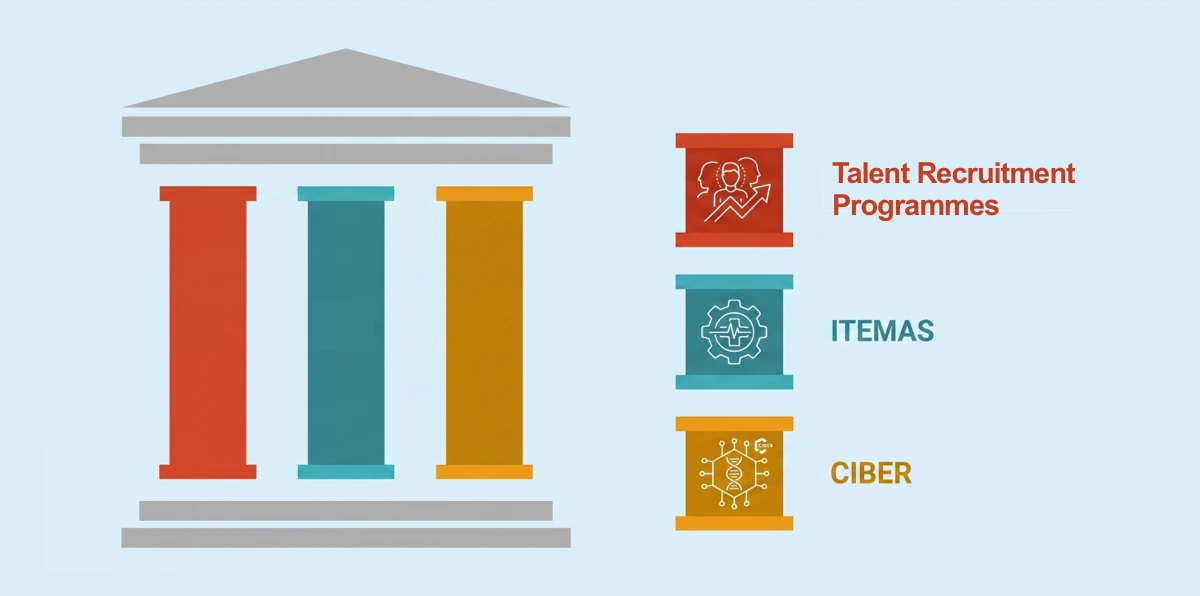
• In Spain, two types of instruments have been particularly decisive: talent recruitment programmes, such as ICREA and Ikerbasque, and platforms/networks for dynamisation and innovation, such as ITEMAS and CIBER.
• ICREA and Ikerbasque have demonstrated that the selective and stable recruitment of excellent researchers generates high-impact publications, competitive European projects, team building and spin-offs.
• ITEMAS has professionalised hospital innovation and strengthened hospitals’ capacity to bring results to the market and the healthcare system.
• CIBER has consolidated a national cooperative model that connects basic, clinical and technological research around specific biomedical challenges, promoting translational research.
Healthcare innovation requires more than just one-off funding or brilliant researchers working in isolation. It requires an institutional architecture: a set of instruments, rules and organisations that make it possible to attract talent, connect disciplines, share risks and transform knowledge into clinical, technological and business solutions. When such an architecture exists, innovation ceases to depend on individual efforts and becomes a structural capacity of the system. And when it is lacking, even environments with excellent science tend to miss out on opportunities for transfer, scaling and impact.
In the Spanish case, two instruments have proved particularly relevant in underpinning this architecture. The first are talent recruitment tools, exemplified by ICREA in Catalonia and Ikerbasque in the Basque Country. The second are the platforms and networks for dynamisation and innovation, notably ITEMAS and CIBER, both linked to the Carlos III Health Institute. Together, these mechanisms have helped resolve two classic bottlenecks in the system: the difficulty in attracting and retaining international excellence, and the difficulty in translating health research into applied innovation.
ICREA, established by the Government of Catalonia in 2001, offers permanent positions to attract top-tier researchers and place them in Catalan universities and research centres. By 2024, it had 299 research professors, and its annual output exceeded 2,000 publications, with around a third of its work ranking among the top 10% most cited. Furthermore, ICREA presents itself as a global community strongly oriented towards excellence, and its 2024 annual report highlights its researchers’ ability to attract competitive funding, open up new scientific avenues and bring technologies to market. This combination of stability, high standards and scientific freedom explains why environments with ICREA researchers consistently rank among the most competitive in European calls for proposals, particularly those of the ERC.
The case of Ikerbasque is equally illustrative. The foundation, promoted by the Basque Government, according to its 2025 data, had a community of 417 professionals, secured over 49 million euros in research funding and had 1,346 externally funded projects, including five new ERC projects. Furthermore, groups led by Ikerbasque staff employed 1,685 professionals and were involved in 48 spin-offs. These figures are significant because they show that talent policy not only improves academic indicators; it also boosts scientific employment, economic returns and entrepreneurial capacity.
Whilst ICREA and Ikerbasque strengthen the talent pillar, ITEMAS acts on the pillar of boosting hospital innovation. ITEMAS was established on the initiative of the ISCIII in 2010 as an innovation network in medical and healthcare technologies, and since 2014 has operated as a platform with a clear focus on transfer to the productive sector. Its current mission is to boost the industrial capabilities generated within the National Health System and to facilitate the effective transfer of research results. Beyond the formal definition, its value has lain in creating a network of managers and units supporting innovation in hospitals, professionalising processes that were previously fragmented. It is no coincidence that the platform itself highlights how ITEMAS has enabled clinical ideas to be channelled towards practical application and generated social and economic returns.
For its part, CIBER, established in 2006 under the auspices of the ISCIII, represents the country’s major cooperative network for biomedical research. CIBER’s significance lies in its creation of a stable space for collaboration, segmenting different areas of interest among basic, clinical and technological groups—something essential for translation. Its own strategic plan specifically highlights this capacity to “build bridges” and facilitate coordinated work between different profiles and stages of development which, outside such a network, rarely interact with the same intensity.
The experience of ICREA, Ikerbasque, ITEMAS and CIBER demonstrates that innovation in healthcare is not accelerated solely by more resources, but by better institutional instruments. Talent programmes create critical mass, prestige and return; innovation platforms and networks convert that scientific capital into collaboration, transfer and clinical application. In this sense, they have marked a turning point in the Spanish ecosystem: they have raised standards of excellence, made hospitals more receptive to innovation and fostered a results-oriented culture of cooperation. Maintaining and strengthening these kinds of tools is not optional; it is a necessary condition for innovation in healthcare to cease being sporadic and become a structural advantage of the system.