



15 Sep mRNA vaccines for the future of medicine
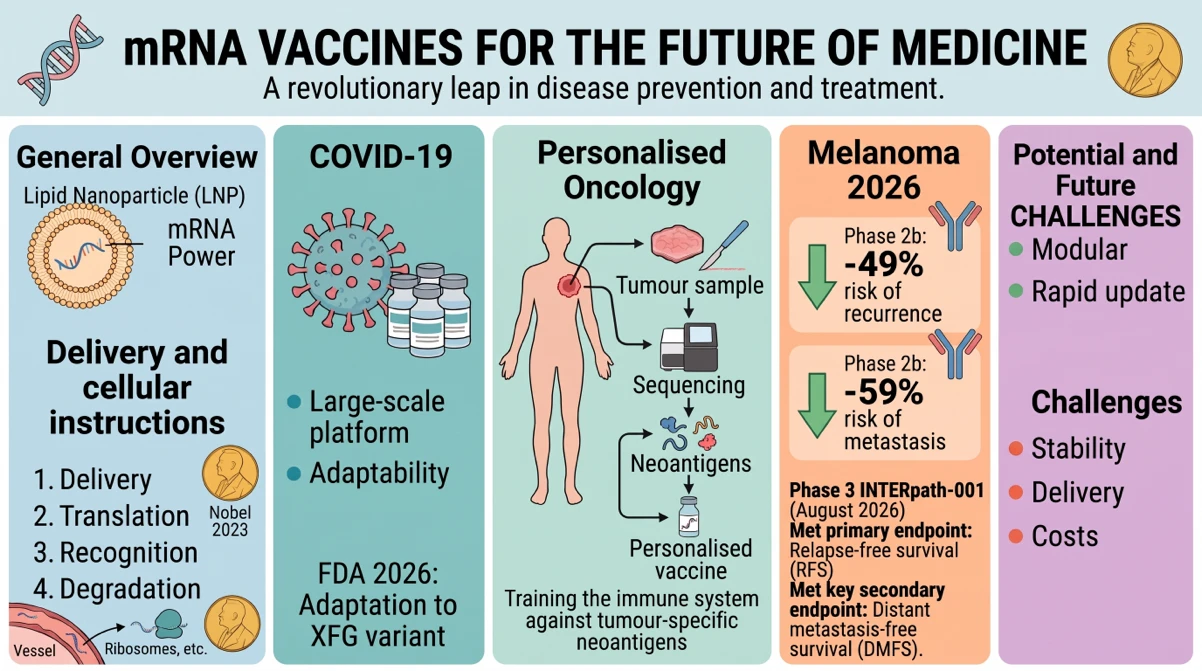
• The COVID-19 pandemic transformed mRNA technology into a large-scale clinical platform and demonstrated its ability to rapidly design and update vaccines in response to new antigens.
• mRNA acts as a temporary instruction for cells to produce a target protein and trigger an immune response; nucleoside modifications and lipid nanoparticles were crucial in making this technology viable.
• In oncology, personalised therapeutic mRNA vaccines aim to teach the immune system to recognise tumour-specific neoantigens. Melanoma has become one of the most advanced examples.
• The positive results reported in 2026 for a phase 3 trial in melanoma reinforce the potential of mRNA.
For decades, messenger RNA (mRNA) was a promising laboratory tool. The COVID-19 pandemic changed that perception. The technology enabled vaccines to be developed at an unprecedented speed and administered on a large scale, transforming an experimental platform into one of the most recognisable biomedical innovations of recent years. This breakthrough not only had an impact in the fight against SARS-CoV-2: it opened the door to a new way of conceiving vaccines and treatments, based on sending precise and temporary biological instructions to the body.
The principle is relatively simple. mRNA carries the information needed for cells to produce a specific protein. In a vaccine, that protein acts as an antigen and enables the immune system to learn to recognise it. mRNA does not need to enter the cell nucleus, where DNA is located, and is broken down after fulfilling its function. To make this process clinically viable, it was necessary to resolve issues relating to stability, delivery and unwanted immune activation. The nucleoside modifications developed by Katalin Karikó and Drew Weissman, recognised with the 2023 Nobel Prize in Physiology or Medicine, and the use of lipid nanoparticles as a delivery vehicle were two fundamental breakthroughs.
COVID-19 served as the ultimate proof of concept. Once the genetic sequence of SARS-CoV-2 was known, BioNTech—founded in 2008 by Uğur Şahin, Özlem Türeci and Christoph Huber—applied this technology and, together with Pfizer, developed BNT162b2, the vaccine subsequently marketed as Comirnaty, a project in which Katalin Karikó, who had joined the company in 2013, also played a part.
From there, the processes of development, clinical trials, manufacturing and surveillance made it possible to make vaccines available within an extraordinarily short timeframe. Subsequent experience has also revealed a strategic advantage: the sequence can be updated to respond to the virus’s evolution without having to completely reinvent the platform. In the United States, for example, in 2026 the FDA recommended, for the 2026–2027 season, a monovalent formulation targeting XFG, a variant of SARS-CoV-2 belonging to the family of lineages derived from JN.1, illustrating the adaptability of the approach.
But the scope of mRNA is no longer limited to COVID-19. The approval of an mRNA vaccine against respiratory syncytial virus in adults confirmed that the platform can be applied to other infectious diseases. At the same time, research has expanded to include influenza, cytomegalovirus and other pathogens, as well as therapeutic applications that go far beyond the prevention of infections.
Furthermore, one of the fields generating the most excitement is oncology. Here, it is important to distinguish between a preventive vaccine and a therapeutic cancer vaccine. In melanoma, the aim is not to vaccinate healthy people to prevent the tumour from developing, but to train a patient’s immune system to recognise specific molecular characteristics of their cancer and reduce the risk of it recurring after initial treatment.
This personalised strategy begins with a tumour sample. Through sequencing and bioinformatic analysis, mutations capable of generating neoantigens are identified; that is, abnormal proteins that can distinguish tumour cells from healthy cells. A patient-specific mRNA is then designed to encode a selection of these neoantigens. Once administered, the aim is to elicit a T-cell response directed against cells displaying these tumour markers. In this sense, the mRNA functions as a programmable platform: the technological ‘architecture’ remains the same, whilst the message can be adapted to the biology of each tumour.
Melanoma is currently one of the most advanced clinical examples of this concept. Intismeran autogene, formerly known as mRNA-4157 or V940, is a personalised mRNA-based neoantigen therapy that can encode up to 34 neoantigens selected from each patient’s tumour. It is being studied in combination with pembrolizumab, an anti-PD-1 immunotherapy that acts on the PD-1 checkpoint – the ‘T-cell brake’ – helping the immune system to maintain an active anti-tumour response.
The data have been particularly significant in 2026. In the five-year follow-up of the phase 2b ‘KEYNOTE-942’ trial, the combination of intismeran autogene and pembrolizumab showed a 49 per cent reduction in the risk of recurrence or death and a 59 per cent reduction in the risk of distant metastasis or death compared with pembrolizumab alone. Subsequently, in August 2026, Merck and Moderna announced that the Phase 3 “INTerpath-001” trial, conducted in patients with completely resected high-risk cutaneous melanoma, met its primary endpoint of relapse-free survival and a key secondary endpoint of distant metastasis-free survival. Detailed results have yet to be presented and evaluated, and the therapy remains investigational, but this milestone represents an important development for the field of personalised cancer vaccines.
The potential of mRNA stems from several characteristics: its modular design, the ability to rapidly modify the sequence, the fact that its manufacture is based on standardisable synthetic processes, and the fact that a single platform can encode very different antigens. In oncology, this flexibility paves the way for increasingly personalised treatments, designed on the basis of the molecular characteristics of each patient’s tumour. Therapeutic mRNA vaccines are an example of this shift towards more personalised immunotherapy and represent a promising avenue within precision medicine. Furthermore, in the field of infectious diseases, this ability to rapidly modify the sequence allows vaccines to be adapted to new pathogens or emerging variants without having to develop a new platform from scratch. Experience with COVID-19 demonstrated this flexibility, which has already been extended to other infections, such as respiratory syncytial virus, and research is continuing into its application against influenza, cytomegalovirus and other pathogens.
However, the future of this technology will depend both on its results and on its ability to overcome challenges that remain unresolved. These include improving stability and storage, refining delivery systems to target mRNA at specific tissues, optimising the duration and quality of the immune response, reducing manufacturing times and costs for personalised therapies, and demonstrating safety and clinical benefit for each new indication.
mRNA is not a one-size-fits-all solution for all diseases, but it is a platform with the potential to transform how certain vaccines and treatments are designed. COVID-19 demonstrated that it could work on a global scale; melanoma is showing just how much it can be personalised to combat a complex disease. If ongoing trials confirm its efficacy and the challenges of manufacturing, delivery and access are resolved, mRNA vaccines and therapies could become one of the most versatile tools in precision medicine over the coming decades.