



11 Dec The need to promote entrepreneurship among young people
Article by Ariadna Teixidó – Consultant and Communication Manager at GENESIS Biomed
• Youth entrepreneurship emerges as a natural response to a changing environment, where young people seek to transform ideas into real solutions and face social challenges with creativity, initiative and purpose.
• The education system still lacks an entrepreneurial culture, both in schools and universities.
• Spain maintains lower rates of entrepreneurship than other countries, conditioned by structural barriers such as administrative complexity, lack of support and difficult access to funding.
• High-risk sectors such as biotechnology require specific support, due to the high costs, long lead times and high scientific uncertainty faced by entrepreneurs.
In a global context in which innovation has become a driver of progress, fostering entrepreneurship among young people is not only an economic opportunity, but a social necessity. Innovation means daring to look at reality with different eyes, questioning the status quo and seeking creative solutions to the challenges of the present. In this sense, entrepreneurship acts as the bridge between imagination and action, transforming ideas into projects with real impact.
Fostering entrepreneurship among young people does not only mean training future entrepreneurs, but also cultivating an attitude based on initiative, curiosity and the ability to turn challenges into opportunities. Today’s young people are growing up in a changing, interconnected environment full of possibilities. They are looking for projects with purpose, that respond to real challenges and that add value to society. For them, entrepreneurship is not only about creating a company, but also about generating change: transforming a concern into a useful proposal, a problem into a solution or an idea into a project that inspires others.
In this scenario, education and support play an essential role. Fostering an entrepreneurial culture from an early age means offering tools that develop creativity, critical thinking and the ability to work in a team. It also involves teaching how to manage uncertainty and take risks responsibly, learning from each experience.
For this mentality to be consolidated, an educational environment that encourages and supports it is necessary. Classrooms must be spaces where imagination is valued as much as knowledge, and where young people can experiment, make mistakes and learn by doing. Something similar is happening in universities: although there are more and more initiatives and innovation centers, the impetus comes late. Many students only come into contact with entrepreneurship through specialised master’s degrees or postgraduate programmes that attempt to correct a lack of basic training. Mentors, hands-on training and collaborative environments not only boost innovation, but also strengthen young people’s confidence in their own potential.
This educational reality is compounded by a labour market that directly influences young people’s decisions. In Spain, youth unemployment remains structurally high, but the majority of young people still aspire to stable employment. This preference for stability and economic security makes it difficult for entrepreneurship to be perceived as a real career option, often placing it as a secondary or riskier alternative. This means that Spain has lower rates of youth entrepreneurship than other neighbouring countries. Although thousands of new projects are born every year, many do not manage to consolidate beyond the first few years of life. Statistics show a high drop-out rate, which is also due to structural barriers and the lack of an environment that really facilitates entrepreneurship.
Among the most frequently mentioned barriers are the lack of policies that really favour the creation of new companies, as well as the administrative complexity faced by anyone who decides to start up a business. Starting a new project involves lengthy procedures, high costs and a large investment of time that discourages young people in particular. Moreover, existing youth entrepreneurship support programmes are fragmented between autonomous communities, city councils, chambers of commerce and state bodies. This dispersion makes it difficult for young people to clearly identify the resources available and to follow a coherent itinerary from the idea to the consolidation of the project. There is a lack of a comprehensive, homogeneous and scalable model that unifies criteria, simplifies processes and provides a clear path for those who decide to become entrepreneurs.
In sectors such as biotechnology, these barriers multiply. Entrepreneurship in biotech is particularly complex because the timescales are long, development costs are high and the failure rate is high. Science does not always deliver the expected results, and experimental validation involves risks that do not depend solely on the efforts of the entrepreneur. Many projects with great potential do not make progress because the financial cost of sustaining them exceeds the capacity of their founders. This makes it all the more important in this area to have strong support mechanisms in place that allow risk-taking without becoming an unbearable financial burden.
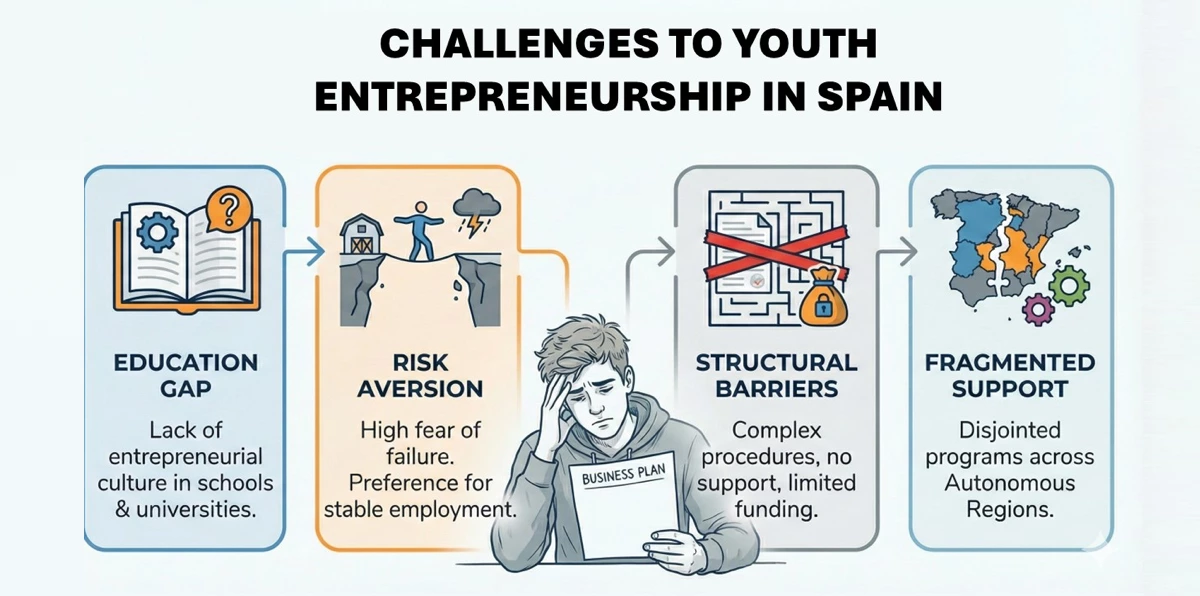
The following is a summary of the main factors holding back youth entrepreneurship that need to be addressed as a matter of priority.
| Key aspects holding back youth entrepreneurship in Spain |
| Educational system with a lack of entrepreneurial culture, especially in compulsory and university stages. |
| High perception of risk and failure. Stability-oriented employment preferences. |
| There are structural barriers: complex procedures, lack of administrative support and limited access to financing. |
| Fragmented public support programmes in the Autonomous Regions. |
The challenge is now a collective one: institutions, companies, universities and society must commit to building an environment that facilitates and accelerates the creation of new projects. Promoting an entrepreneurial culture involves reducing barriers, simplifying processes and offering tools that allow young people to transform their ideas into viable initiatives.
It is important to remember that youth entrepreneurship is one of the key drivers of the economy of the future, driving innovation, the creation of quality jobs and the modernisation of the production system. Furthermore, business initiatives led by young people make a decisive contribution to social development, favouring intergenerational mobility, inclusion and the generation of new opportunities in the territories. It is therefore essential to eliminate these barriers in order to take full advantage of the entrepreneurial potential of this sector of the population, which represents the pillar of the economic and social development of any country.