



19 Feb The impact of digital twins on personalised medicine
Article by Ariadna Teixidó – Consultant and Head of Communications at GENESIS Biomed
• Digital twins make it possible to simulate personalised clinical scenarios without intervening directly on the patient, reducing uncertainty in decision-making.
• Their value in personalised medicine lies in anticipating individual response to treatments/interventions, avoiding approaches based exclusively on population averages.
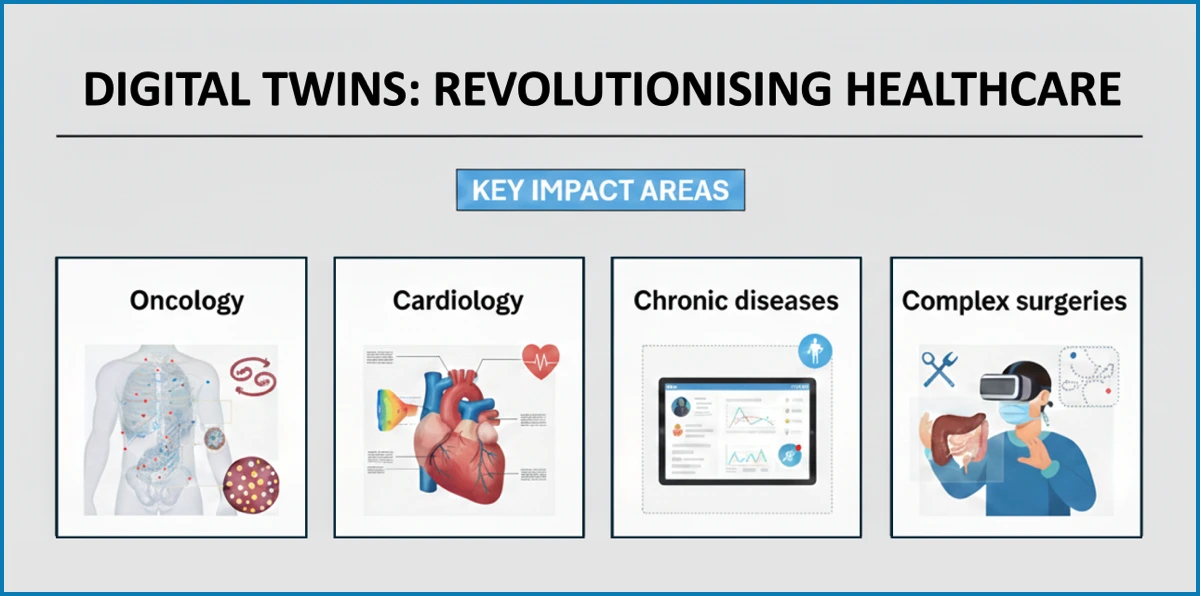
• In areas such as oncology, cardiology, chronic diseases and complex surgery they can provide predictive support for complex and sequential decisions.
• Their impact will depend on solid clinical validation, quality data and real integration into the care flow.
Personalised medicine pursues an idea that is as simple as it is ambitious: that the right treatment reaches the right patient at the right time. However, in clinical practice, many decisions are still based on probabilities derived from population averages. A drug is considered effective because, in a large group of patients, it improves outcomes. But at the individual level, an unavoidable question remains: will it work in this particular person, with this particular clinical history, genetic profile, comorbidities and particular course? It is in this context that digital twins begin to gain relevance.
A digital twin applied to health can be defined as a dynamic virtual representation of a patient, or of a specific part of their organism, which is fed by real data and continuously updated. What is truly different is not the existence of a model per se, but its permanent connection with real clinical information that makes it possible to reflect the state of an individual or part of an individual. This moves from generic simulations to personalised simulations based on observed data.
In personalised medicine, the fundamental purpose of the digital twin is to support decision-making. It allows testing clinical scenarios without directly intervening on the patient: simulating different doses, comparing therapeutic strategies, estimating the risk of adverse events based on individual parameters, or analysing surgical intervention strategies. This capability is particularly valuable in complex pathologies, where the balance between benefit and risk is delicate and each decision has significant implications.
To anticipate the response to a treatment in a particular patient, the digital twin integrates heterogeneous data which, depending on the case, may comprise clinical history, analytical results, physiological signals, medical imaging, previous treatments, genetic or molecular information, etc. With each new piece of information, the model can be recalibrated and adjusted, improving its accuracy. The potential impact is considerable: reducing trial and error, avoiding ineffective therapies/interventions and optimising personalisation.
The development of digital twins has been made possible by the increasing availability of clinical data and the current ability to analyse it in an integrated way. This combination allows simulations to become increasingly accurate and useful for healthcare practice.
In practice, simulation is no longer a theoretical exercise but a clinical support tool. A digital twin can estimate the evolution of a marker or project the probability of response to a specific therapy or optimise the strategy of a surgical intervention. Always under an essential premise: these are probabilistic predictions that reduce uncertainty, but do not eliminate it.
Areas where the impact may be most visible
- In oncology, where treatment often involves a sequence of decisions, initial therapy, response assessment, adjustments or combinations, a digital twin fed by image data, biomarkers and time course could help anticipate responses or detect early signs of therapeutic resistance.
- In cardiology, advanced image integration allows simulating flows and pressures, exploring the potential impact of different interventions before they are performed. It is not a substitute for clinical expertise, but can provide additional information in highly complex cases.
- In chronic diseases such as diabetes, COPD or asthma, where continuous monitoring and therapeutic adjustments are frequent, the digital twin can act as a dynamic history and predictive tool to facilitate prevention of decompensation and personalisation of daily management.
- In complex surgery where the patient’s anatomy and the relationship with critical structures determine the strategy. A digital twin built from CT/MRI and 3D segmentation and, where appropriate, complemented by biomechanical or haemodynamic simulations, can help plan trajectories and approaches, estimate resection volumes and margins, and anticipate risks.
If their development and adoption progresses rigorously, digital twins could contribute to:
- Reduce the trial-and-error approach to therapeutic selection.
- Early identification of non-responders.
- Optimise doses and timing of intervention, especially for drugs with high inter-individual variability.
- Increase the success of complex surgical interventions.
- Improve clinical communication through more understandable comparative scenarios.
Beyond the clinical impact, these improvements could translate into greater efficiency of the healthcare system and a better patient experience by reducing uncertainty and decisions made with limited information.
However, the promised impact will not be automatic. The real utility of a digital twin depends on its reliability. This requires robust clinical validation that demonstrates improved decisions and outcomes in different care settings, rigorous control of biases in training data, effective interoperability between systems, and quality and consistency of information. It also requires a clear regulatory framework in terms of traceability and accountability. In addition, there is a decisive factor: its integration into the clinical workflow. Without a practical fit and tangible value, any tool runs the risk of remaining in the pilot phase.
The impact of digital twins on personalised medicine is not to completely digitise the patient, but to develop sufficiently robust models to compare and anticipate therapeutic outcomes in specific individuals, based on real and up-to-date data. Their greatest contribution is not to eliminate clinical uncertainty, but to significantly reduce it. If developed with scientific rigour and clinical sense, they can become a key tool for bringing medicine closer to its most essential objective: to treat each person better, not just the disease in the abstract.