



26 Mar Josep Samitier – Nanobioengineering group leader at IBEC and former director of IBEC
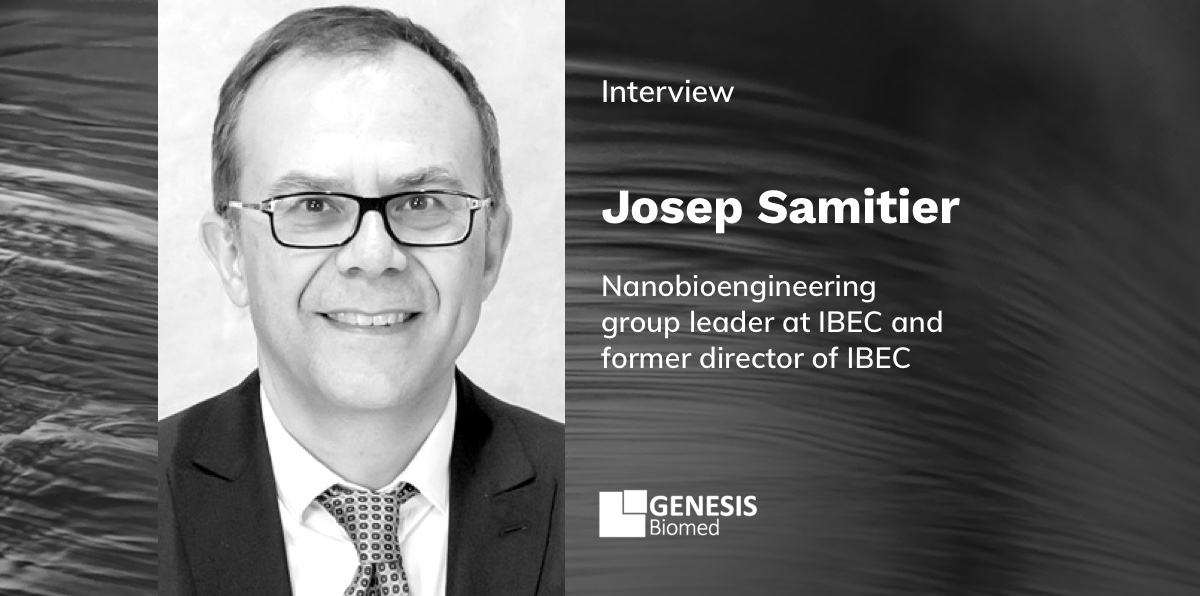
Josep Samitier: “It’s key to strengthen public-private collaboration and attract venture capital to promote emerging projects that will allow us to consolidate technological and productive capacities in new diagnostics and advanced therapies in the future”.
Josep Samitier is a professor in the Department of Electronic and Biomedical Engineering at the University of Barcelona and leader of the Nanobioengineering group at IBEC and has been director of the Institut de Bioenginyeria de Catalunya (IBEC) for 11 years. He currently leads the new centre for Applied Theragnostics (Fraunhofer CAT) in Spain, promoted by the Fraunhofer Gesellschaft. He is also principal investigator at the Centre for Biomedical Research Network on Bioengineering, Biomaterials and Nanomedicine (CIBERBBN) and a member of the Institut d’Estudis Catalans (IEC). Throughout his career he has promoted research and innovation in nanomedicine and bioengineering. He is the coordinator of the NANOMED Spain platform and a founding member of EIT Health, contributing to the development of innovation in health on a European scale. He currently coordinates the Complementary Plan for Biotechnology Applied to Health, promoted by the Ministry of Science and Innovation. He is also a member of the Expert Group on Biotechnologies’ Risk Assessment within the framework of the European Economic Security Strategy. His career has been recognised with the City of Barcelona Award for Technological Innovation (2003) and the Narcís Monturiol Medal for scientific and technological merit (2020).
After more than a decade at the helm of IBEC, what would you say have been the most important milestones of your time as director, both scientifically and institutionally?
Growing the institution and consolidating it as a leading international research institution in the field of bioengineering. The achievement and maintenance of the Severo Ochoa mention of excellence awarded by the Ministry of Science and Innovation since the 2014 call for applications in three consecutive periods has been the result of the ability to attract international talent through the ICREA programme and the support to young researchers to start their research as independent researchers has allowed the achievement of a large number of international projects led by our researchers, such as those awarded by the European Research Council. Likewise, the consolidation of a research support structure has enabled IBEC to develop programmes for the dissemination of science, collaboration with schools and cultural and artistic institutions.
From a scientific point of view, after twenty years IBEC has managed to develop an interdisciplinary frontier science that has allowed us to discover remarkable advances in how the mechanical forces between cells are relevant in processes such as cancer metastasis. How to design small particles, nanoparticles and nanomotors, to cross physiological barriers in our body to deliver drugs to the right place more efficiently, or how to better understand the process of organ regeneration, allowing the development of true biological tissue engineering with technologies such as 3D bioprinting.
In the field of biotechnology, interaction with the clinical environment is key. What role does IBEC’s Clinical Translation Committee play in connecting basic research with clinical practice?
Connecting with healthcare professionals is fundamental. Understanding clinical needs. The problems in the diagnosis and treatment of patients is fundamental to be able to direct scientific knowledge towards results that can be used in clinical practice. It is a process of continuous feedback: unresolved challenges are a stimulus for new ideas and in turn frontier knowledge serves to define new technologies and therapeutic alternatives that had not been explored until then.
You have been a key figure in the promotion of nanomedicine in Spain and Europe. With hindsight, what expectations do you think have been fulfilled and which have been more difficult to realise?
I was lucky enough to be able to start IBEC’s great adventure at a time when nanomedicine was being developed worldwide. That is, the development of nanotechnology applied to diagnosis and therapy. In this 21st century, of which we have already covered a quarter, we have been able to see different nanodrugs being approved and how the resolution of techniques such as MRI or PET improved with the use of nanoparticle probes. The response to the COVID-19 pandemic has led to the accelerated development of RNA vaccines, which require lipid nanoparticles to work, and which have opened up great prospects for new vaccines and the development of à la carte immunology.
In gene therapy and tissue and organ regeneration, nanomedicine has also provided new options that will surely lead to spectacular advances in the coming years.
Having been able to collaborate in promoting the Spanish Nanomedicine Platform and its European counterpart, the European Nanomedicine Platform, has made it possible in these more than twenty years to generate a loudspeaker and help generate synergies for the advancement of science in this field.
In an ecosystem as competitive as the Catalan one, where many leading centres in biomedicine converge, to what extent is attracting and retaining talent a challenge?
The major frontier science topics in the 21st century follow a dynamic of competition on a global scale. Any breakthrough or new technology is immediately replicated or used in another part of the world. At the level of Catalonia, the challenge is how to be efficient with limited resources. Attracting and retaining talent is a complex task in an environment where mobility and the search for resources to develop science is a constant. Therefore, it is essential to generate a real ecosystem where the existence of good universities, research centres, scientific infrastructures and hospitals of reference in a nearby environment makes biotech and pharma companies decide to establish and develop. The concept of the Bioregion of Catalonia has been very efficient in visualising this true scientific hub in southern Europe. This vision of complementarity helps to ensure that talent wants to stay because there are opportunities and that international talent also wants to participate in this development.
How do you assess the evolution of the Spanish biotech ecosystem over the last 15-20 years and what role do you think IBEC can continue to play in its future development?
The Spanish ecosystem has undergone a great evolution in recent years. At the scientific level it has been able to position itself among the advanced countries of Europe in terms of results, although we are still below the European average in terms of GDP investment in R+D. Various autonomous communities have developed specific strategic plans, which in recent years have come together in the PERTE de Salud de Vanguardia, which should give new impetus to biomedical research. In this sense, it is now essential to develop mechanisms for public-private collaboration and to attract and involve venture capital in emerging projects in order to consolidate a change in technological and production capacity in new diagnostic systems and in advanced and emerging therapies as a result of the basic and clinical research that is being developed. In this context, bioengineering and in this case the Institute for Bioengineering of Catalonia (IBEC) has a great future to develop and expand towards new frontiers of knowledge where understanding and controlling biological processes will certainly be useful not only to improve health but also in the sustainability of our planet. In the shorter term, initiatives such as the development of the new Hospital Clínic in the Diagonal area with the joint clinical axis with the Hospital de San Joan de Deu, the Hospital Universitari de Bellvitge and the scientific one that involves the Barcelona Science Park or the development of the “Mercat del Peix”, area near the beach, are two projects that will generate great synergies and opportunities for IBEC.